

Palatal Expanders – Richardson, TX
A Guide for Proper Jaw Development
Here at Richardson Orthodontics, we offer a number of orthodontic appliances that are designed to support the long-term success of our patients’ treatments. One such appliance is known as a palatal expander, which we sometimes prescribe as part of phase 1 orthodontic care. An expander serves as a guide for proper development of the upper jaw, which can open the way for the incoming teeth to emerge in their ideal positions. Would you like to learn more about palatal expanders? Read on below.
Why Choose Richardson Orthodontics for Palatal Expanders?
- Personalized Care for Each Patient
- Experienced, Compassionate Orthodontic Team
- Custom Appliances Made In-House
What Is a Palatal Expander?
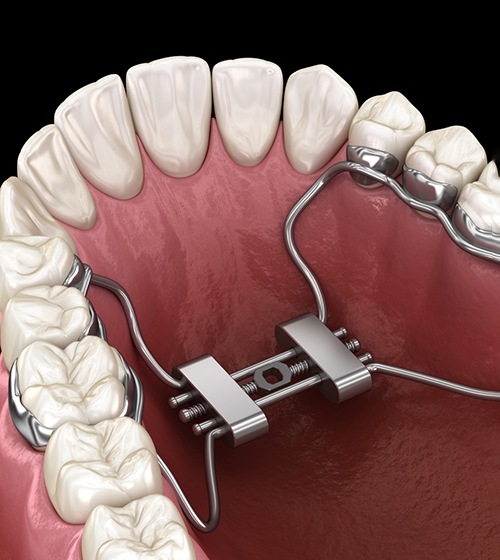
A palatal expander is a custom-made orthodontic appliance that applies gentle pressure to a young patient’s hard palate (upper jaw, the roof of the mouth) in order to gradually widen it over time. Its goal is to create space so there is enough room for all of a patient’s teeth to function properly in their ideal positions.
Typically, palatal expanders are best used in patients between the ages of 5 and 16. They may be recommended when an individual has one or more of the following orthodontic issues:
- Crossbite
- Overcrowding
- Impacted teeth
- Difficulty breathing through the nose due to a narrow upper airway
How Does a Palatal Expander Work?

In most cases, a palatal expander is attached to a patient’s molars (back teeth) via small metal rings. Some expanders are removable, whereas others are not. Regardless of whether the device is removable, it should have an expansion screw that will gradually widen the expander and thereby widen the patient’s upper jaw.
Most patients wear a palatal expander for 6 – 12 months. At the end of that time period, their mouths should have enough space to comfortably accommodate all of their adult teeth in their upper jaw.
How Should a Palatal Expander Be Kept Clean?

Oral hygiene for a palatal expander is pretty simple. If the device is not removable, it should be cleansed with toothpaste and gentle brushing a few times each day. A water flosser could prove to be a valuable tool because it can remove plaque buildup from areas that are difficult to reach with a toothbrush.
If the appliance is removable, it should be taken out of the mouth and receive regular cleanings so it can stay fresh and odor-free.
Does a Palatal Expander Cause Pain?

We want our patients to be as comfortable as possible throughout treatment. However, the nature of orthodontic treatment requires that pressure be placed on the oral structures. This can cause some soreness. A palatal expander may be particularly uncomfortable when it is first placed, as well as when it is adjusted. We will provide helpful tips to minimize the pain your child experiences during their treatment.
Palate Expanders FAQs
Can Palate Expanders Be Used on Teens and Adults?
Palatal expanders are usually used on children; their bones are still developing, so they tend to respond more easily to orthodontic intervention. However, even if you are older, there is still a chance that you could benefit from palatal expansion. The process may be longer and involve a more complex approach to treatment since the palate’s flexibility diminishes with age. You might even need to undergo a surgery for the expansion to be successful.
Before our Richardson team recommends palatal expanders for anyone, we thoroughly evaluate the details of the case with the goal of providing effective and conservative care.
Are There Any Eating Restrictions with a Palate Expander?
If your child gets a palatal expander, you might need to help them make some dietary adjustments. Certain foods, such as those that are sticky, chewy, or hard, can pose a risk to the expander; they might loosen or damage its components. In turn, that could delay the treatment’s progress and necessitate costly repairs. To avoid such challenges, we advise you to give your child mostly soft foods that do not require a lot of chewing.
Our team can give you a comprehensive list of specific foods to avoid during treatment with a palatal expander. If you have questions about how to make sure your child gets a nutritious diet during their treatment, feel free to ask!
Here are a few specific foods that should be avoided while a patient has a palatal expander:
- Popcorn
- Hard candies
- Chewing gum
- Caramel
- Tough meats
Things like pasta, eggs, steamed veggies, and bananas are better choices.
Important note: If your child’s expander is removable rather than fixed, they will have fewer dietary restrictions since their appliance can be taken out at mealtimes.
What Should Happen After Treatment with a Palate Expander?
Once the expander has done its job, we will remove it from your child’s mouth and thoroughly evaluate how their bite and dental alignment have improved. Most patients find that their oral function is greatly enhanced! Your child’s facial profile may also improve.
Of course, the treatment process does not stop there. A retainer may be necessary to help the upper jaw maintain its new position.
Your child might also need braces or clear aligners to further adjust the positioning of their teeth.
What Should I Do if My Child’s Expander Breaks?
We understand that accidents can happen, so do not hesitate to call our Richardson team if your child’s palatal expander breaks. Do not try to repair it on your own; you might accidentally worsen the damage! Until you can visit our office, your child should avoid hard foods and refrain from touching the expander.
We view broken palatal expanders as an urgent matter, and we will arrange to see your child ASAP. During their appointment, we will examine the expander and determine if it should be repaired or replaced.